
Simplify your CSS, reduce repetition, and improve readability with five practical techniques that professional front-end developers use every day.
5 Tricks That Will Make Your CSS Cleaner
We’ve all been there: a CSS file that grows endlessly, selectors becoming more specific, overrides piling up, and debugging a layout feels like solving a mystery.
CSS isn’t hard; it’s messy if not structured carefully. Clean CSS doesn’t just make your stylesheets shorter; it makes them easier to maintain, extend, and debug.
In this article, you’ll learn 5 practical tricks to clean up your CSS, with examples and best practices you can apply immediately.
1. Use Variables for Reusable Values
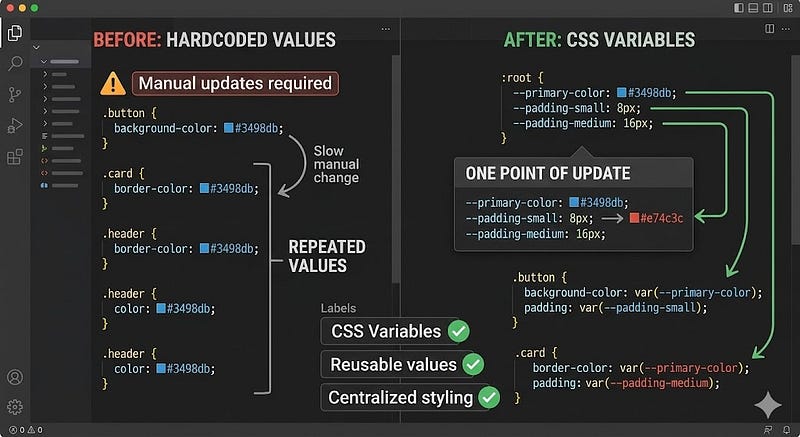
Hardcoding colors, font sizes, or spacing leads to repetition and inconsistency.
Before
.button {
  background-color: #3498db;
  color: #fff;
  padding: 12px 24px;
}

.card {
  border: 1px solid #3498db;
  padding: 16px;
}
If you ever change your primary color, you’ll need to hunt through every occurrence.
After: CSS Variables
:root {
  --primary-color: #3498db;
  --padding-small: 12px;
  --padding-medium: 16px;
}

.button {
  background-color: var(--primary-color);
  color: #fff;
  padding: var(--padding-small) 24px;
}

.card {
  border: 1px solid var(--primary-color);
  padding: var(--padding-medium);
}
Benefits
- Change colors, spacing, or fonts in one place
- Improves consistency across components
- Reduces errors and duplication
2. Group Common Styles
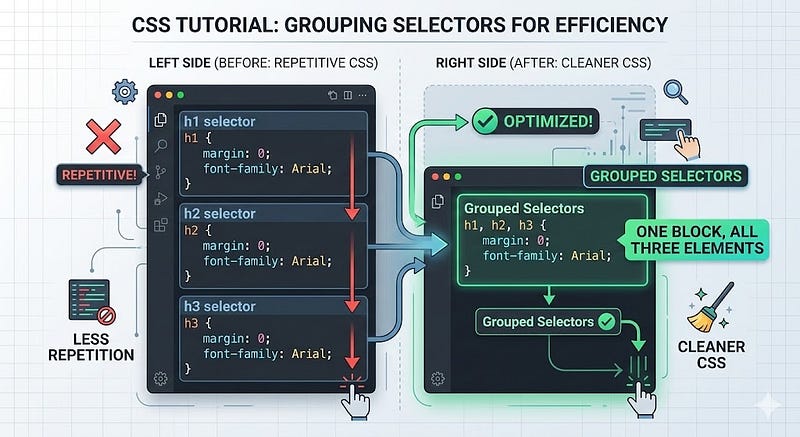
Instead of repeating identical rules, group selectors that share the same styles.
Before
h1 {
  margin: 0;
  font-family: Arial, sans-serif;
}

h2 {
  margin: 0;
  font-family: Arial, sans-serif;
}

h3 {
  margin: 0;
  font-family: Arial, sans-serif;
}
After: Grouped Selectors
h1, h2, h3 {
  margin: 0;
  font-family: Arial, sans-serif;
}
Benefits
- Shorter CSS
- Easier maintenance
- Less chance of introducing inconsistencies
3. Use Utility Classes for Repeated Patterns
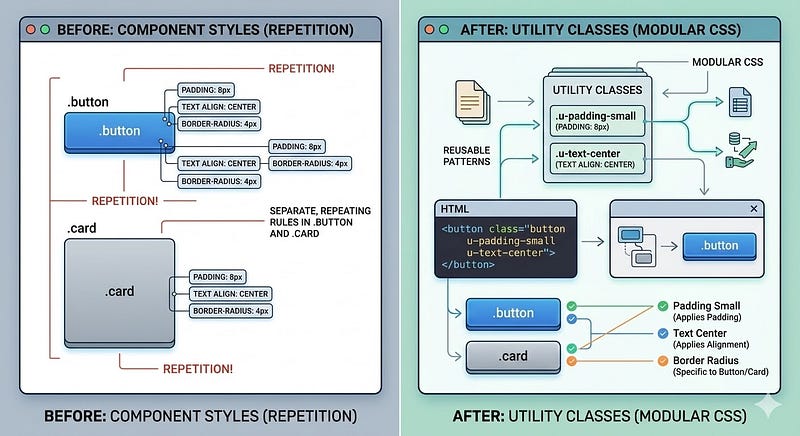
Instead of repeating spacing, alignment, or color styles, create small utility classes.
Before
.button {
  padding: 12px 24px;
  text-align: center;
}

.card {
  padding: 12px 24px;
}
After: Utility Classes
/* Utilities */
.u-padding-small { padding: 12px 24px; }
.u-text-center { text-align: center; }

/* Components */
.button {
  @extend .u-padding-small;
  @extend .u-text-center;
}

.card {
  @extend .u-padding-small;
}
Or with vanilla CSS:
<div class="card u-padding-small"></div>
<button class="button u-padding-small u-text-center"></button>
Benefits
- Reduces duplication
- Encourages consistency
- Makes your CSS modular
4. Avoid Deeply Nested Selectors
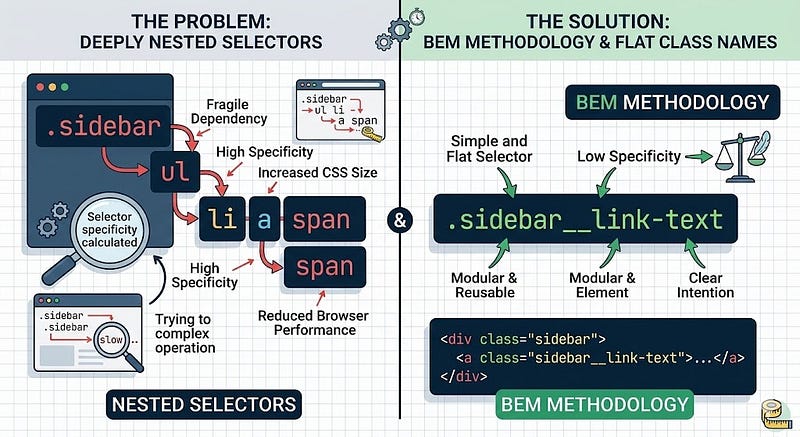
Long chains of selectors are fragile and hard to override.
Before
.sidebar ul li a span {
  color: #333;
  font-weight: bold;
}
- Hard to read
- Hard to maintain
- Easily broken by DOM changes
After: Use Classes or BEM
/* BEM naming */
.sidebar__link-text {
  color: #333;
  font-weight: bold;
}
<ul class="sidebar">
  <li>
    <a href="#" class="sidebar__link">
      <span class="sidebar__link-text">Home</span>
    </a>
  </li>
</ul>
Benefits
- Clear structure
- Easier overrides
- Avoids specificity wars
5. Remove Unused CSS
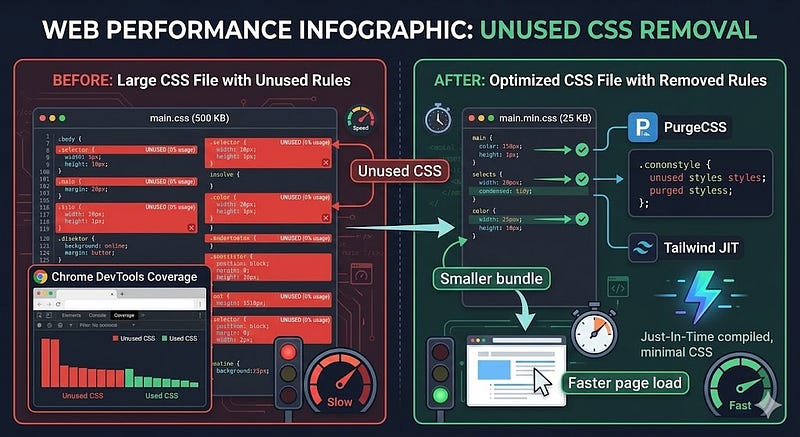
Dead CSS increases file size and slows rendering.
Tools to Identify Unused CSS
- Chrome DevTools Coverage Tab: Shows which styles aren’t used
- PurgeCSS: Removes unused classes during build
- Tailwind CSS JIT: Generates only what’s used
Example with PurgeCSS
// Purge unused classes from Tailwind build
module.exports = {
  content: ['./src/**/*.html', './src/**/*.js'],
  css: ['./src/**/*.css'],
  safelist: ['important-class'],
};
Benefits
- Smaller CSS file
- Faster page load
- Easier to maintain
Key Takeaways
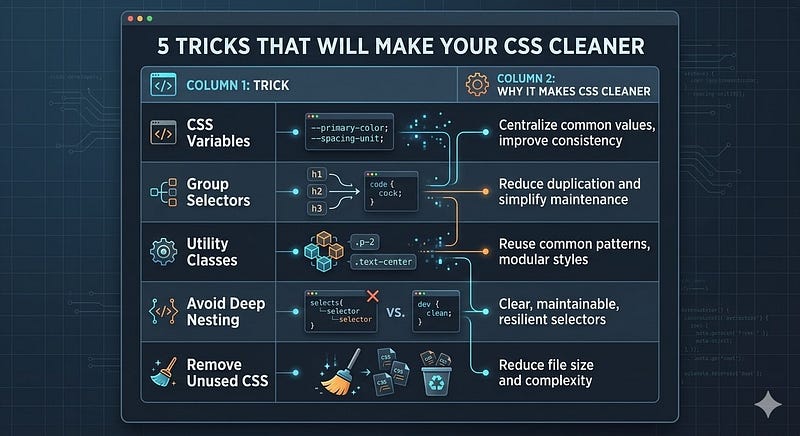
Clean CSS isn’t just cosmetic; it saves time, reduces bugs, and improves performance.
Next Steps
- Audit your CSS for repeated values → convert to variables.
- Identify common styles → group selectors or create utility classes.
- Review long, nested selectors → simplify or adopt BEM.
- Run a CSS coverage tool → remove unused styles.
- Apply these tricks incrementally and measure maintenance benefits.
Even small improvements compound over time and make future projects easier to maintain.
Strong Call to Action
Share this post with a teammate who struggles with messy stylesheets.
Start cleaning your CSS today and see how much faster you can maintain, extend, and scale your front-end code.







Leave a Reply